
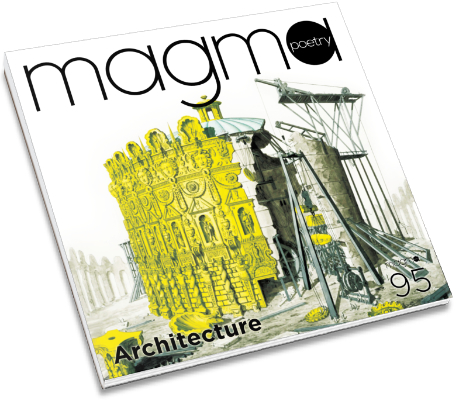
For the Architecture issue, Laura Scott responds with a poem inspired by a building, specifically her childhood home.
**
The house was left; the house was deserted. It was left like a shell on a sandhill to fill
with dry salt grains now that life had left it. The long night seemed to have set in; the
trifling airs, nibbling, the clammy breaths, fumbling, seemed to have triumphed…Idly,
aimlessly, the swaying shawl swung to and fro. A thistle thrust itself between the tiles
in the larder. The swallows nested in the drawing-room; the floor was strewn with
straw, the plaster fell in shovelfuls; rafters were laid bare; rats carried off this and that
to gnaw behind wainscots. Tortoise-shell butterflies burst from the chrysalis and
pattered their life out on the window pane.
———————–To The Lighthouse, Virginia Woolf
**
There are two things that ran their hands over this poem that I’d like to acknowledge. One I was very conscious of – Virginia Woolf’s tortoise-shell butterflies. When Stav and Leo asked me to write a poem for this issue I was, of course, delighted, but not because I thought, at last, I could get those butterflies into a poem. It was rather that once I started to write it and the poem had made the turn where it calls out to and imagines a natural decline for the house, a sort of softening and blurring of it, the butterflies had to come in. It was one of those rare, exciting moments in the writing of a poem where all the doubt and uncertainty just falls away, and you know the move is absolutely necessary and right. The butterflies had to be there.
The second one I wasn’t conscious of at all, or at least, if I was, I tried to keep it out. It lurked in the wings, more or less out of sight for most of the time I was writing. It revealed itself slowly and problematically; it kept messing up the poem, catching and snagging its flow, changing and distorting the cadence of the voice in this poem until I reached some kind of compromise with it.
It is odd that such a slight thing, a memory of a conversation I’d had with a friend years ago, could have had such an effect. We’d been talking about where we’d grown up and I said something about the bit of London I’d grown up in now being unrecognisable. And he’d told me that his childhood house on the Norfolk fens was no longer there. It had been washed away by the rising water levels and when he looked on a map to see where his house had been, the contour lines had changed. And that image – of a washed-away house and a changed map – got stuck somewhere in my head. It had a kind of luminous strangeness to it, a refusal to mean, it just stayed there waiting for the moment to come out. And that moment was this poem.
When I started to write it, the image of the washed away house kept seeping into the words, pulling them in a different direction to the one I wanted to go. So for a short time I tried to fuse the two images together, my architecturally gutted house and the washed-away house. I turned the water into currency, so that while my friend’s house had been literally washed away by rising water levels, mine had been metaphorically washed away by rising property prices. This was ingenious but wrong-headed, so wrong-headed that I had to stop. The voice changed and sounded preachy and the poem became rigid with intention. So I stopped trying to meld and force the two together, and let them do their own thing instead, and as soon as I did, the poem found its form and its footing, as if allowing the stuck image into the poem to see how it behaved, I could then push it into the background where, if it stretched, it could just about run its hands over the poem without distorting its shape.
**
The house’s dream of itself was at its grandest downstairs
Try it like this. There was once a house,
a house of light and landings and airing cupboards,
a house of half-told stories floating around the ceilings.
Or like this. There was once a house and the house
was like a boat sailing the daughters that grew
in it out across the sea.
And inside the house, there was a bedroom
with a big chest of drawers in it
and the bottom drawer
was heavy as a hull
and one of the daughters liked to go to that room
and drag the drawer out to wade in it
with her hands, moving them through the layers
of photos piled up in there
in their unstable shiny towers,
deciding which ones to take out
and lay across the floor
around her so she could look at them
carefully like a hand of cards someone had dealt her.
And there was one that kept floating to the top
of a man in an old red leather frame,
his dark hair sweeping back,
his eyes holding hers
in a slightly stagey stare,
like the photos of actors they sometimes have
on the walls in Italian restaurants. One day
the daughter asked the mother
who he was and the answer –
your sister’s father –
opened up a new space
where meaning lagged and dragged
its feet slowly behind words.
Your sister’s father, but not yours – was that
what she meant?
The daughter had to hold that still
inside her head for the next time she found herself
looking at his face. And the space where she did that
was like finding a secret room in the house
she hadn’t known was there before.
********************
Sometimes two of the sisters were made to share
one of the attic bedrooms.
There was always one
with a room of her own.
And sometimes, when they were bored
the two of them would drag the beds out
from the soft sides of the room where ceiling
sloped so calmly into wall and push them into the middle
and leave them there, rather pointlessly centre stage, until someone
made them put them back. But they loved doing it, moving everything around,
cutting the lines into different shapes so the room shone with a new strangeness
and it felt for a moment, as if they’d moved house or become fledgling architects.
********************
The house’s dream of itself was at its grandest downstairs
where the high white ceilings in the hall and bay-windowed double rooms
stretched out across the first floor. There was a dining room
with hessian wallpaper and french windows with heavy silk
dark orange curtains, ripped at the top by the claws
of an uncle’s parrot who’d flown up
to the pelmet and refused to come down,
or at least, that was the story
the mother liked to tell, and she told it so vividly,
none of them could look at the curtains
without seeing the claws.
********************
But when I went back, all of that
had been smoked out of you.
Your walls had been sealed and smoothed and the rooms siloed
out of all recognition. Repinned and gutted
and knocked into next door,
knocked so hard the double rooms had quadrupled
and a great funnel dropped into the middle
of your space, like a vortex pulling everything
towards it and your proportions took one look
and shuddered and fled
under the doorframes.
It would have been easier, much easier,
if nature had taken you – had crept in
with its damp fingers and worked them
into your cavities, if the tortoise-shell butterflies
had come and flapped their wings against your windows.
**
Laura Scott has two collections with Carcanet: So Many Rooms which won the Seamus Heaney Prize in 2020, and The Fourth Sister which was the Poetry Book of the Year in both The Observer and The Telegraph.
*
Buy this issue for £8.50 in UK (including P&P) »Buy Now
 Supported by Arts Council England