
Malika Booker and Dante Micheaux are fixtures in the firmament of poetry on both sides of the Atlantic and seemingly all points between. For this issue they were asked to read and remix a poem from one another and then be ready to talk about the process, the problems and the product. What follows is a brief, edited version of their conversation with Magma editor Elontra Hall that traces the journey from being inspired by one piece of work to a re-envisioning and creation of something new, in a type of conversation with its parent.
*
E Hall: So first and foremost, I just want to say good evening and welcome. And thank you for being a part of Magma’s remix issue. I’m very glad you two chose to be a part of this issue. I was very excited to see your responses to each other’s work, but I’m equally interested to hear about the behind-the-scenes work that went into the poems.
So the first thing that I’ve been really curious about from each of you is, how did you approach this remix brief?
M.Booker: I suppose for me, I treated it a bit like sampling. Actually, I wanted to kind of do a ‘remix of a remix.’ I wanted to do Stones and Apple together like a double remix. But, thank God, time did not permit me to get into that.
So, I really just took out vocabulary. I took out a lot, a lot of words from his poem and thought about its theme. And, because I’ve been working with a biblical theme for the collection that I’m doing and I’ve been trying to write a poem about Lilith, I then decided, like, ‘why don’t I kind of use that?’
So, it was really kind of I suppose it was really kind of using his vocabulary and then thinking about the symbolism of the fruit and making it place-specific. Mango didn’t work and then I remembered that there’s a fruit called the Mammee Apple, which is one of my favorite fruits. And then it was like, OK, then ‘apple’ will come in as well and be repeated. So that was the kind of the kind of like initial thing that I thought about in terms of remix — thematic vocabulary.
D.Micheaux: I think about remix in the context of Ars Poetica. And so, it really isn’t that different than what I do anyway in my work because I often start with a phrase or a line that I keep in my head for quite a long time.
Usually, when I sit down to write a poem, it is already there for the most part. I might have to change vocabulary, but lineation and rhythm is there because I’ve been mulling over the structure of the poem, the form of the poem, I should say – not the structure – for quite a long time. Ultimately, I went with Death of an Overseer because I’ve been writing — composing a poem for quite a long time called Siege of the Great Plantation. And after listening to your poems speak to me, that one seemed like it was already in dialogue with work that I had been working on for a long time.
E.Hall: It’s really profound, hearing you two speak about the idea that remix is a conversation, more a matter of shifting your perspective to then allow those things to converse more fluidly, and allowing yourself to be the conduit through which that conversation is fully realised and we get something new.
Is a remix its own, new thing?
M.Booker: Yeah. I think it becomes something new. I really liked the kind of sexual undertones in Dante’s poem. And, I suppose it is new because it’s saying, ‘Dude, the mammie apple was here before and I was not from a rib. I was molded.’ So, it’s also there. And, I really wanted to think about — I think Lilith wanted to think about the flesh. That kind of biblical thing is always about the flesh, isn’t it? About sins and the flesh? I wanted Lilith’s voice. And, I wanted Lilith’s relationship with Adam, and her relationship with Eve.
it’s kind of looking at this relationship of this woman to patriarchy, too, I think.
D.Micheaux: That sounds accurate to me from what I’ve read.
I, like the idea of the source poem (Apples) being a homosexual text, and then you converting it to heterosexuality because it’s usually the reverse. In the poem that Malika is referring to, Apples, Adam is fantasizing about men because prior to Lilith and Eve, he only has himself as a reflection. The source for that poem, Apples, is a poem by Toni Morrison called, Eve Remembering. I thought a lot about that poem, it really, really startled me in its truth. And so, it’s interesting to see a full circle movement of return to some aspects of the Morrison poem, which is very feminist in the way that it casts Eve.
E.Hall: What was the most compelling or interesting thing about this brief for each of you, of writing a poem in response to one another? And also, what was the most compelling part of it for you?
*
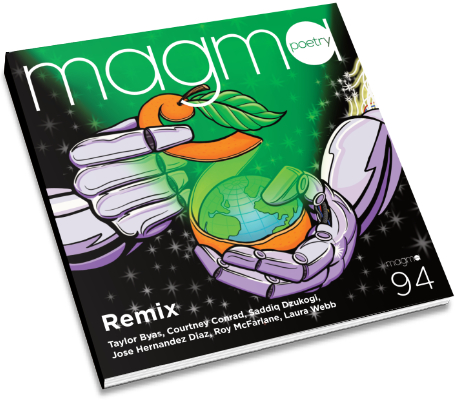
This is an excerpt from the magazine. Find the full article in Magma 94:
Buy this issue for £8.50 in UK (including P&P) »Buy Now
 Supported by Arts Council England